
Last Updated on September 27, 2026
Building backlinks can help people discover your website and understand how your content relates to other resources. But not every backlink is worth pursuing. Links created mainly to manipulate search rankings can violate search engine spam policies.
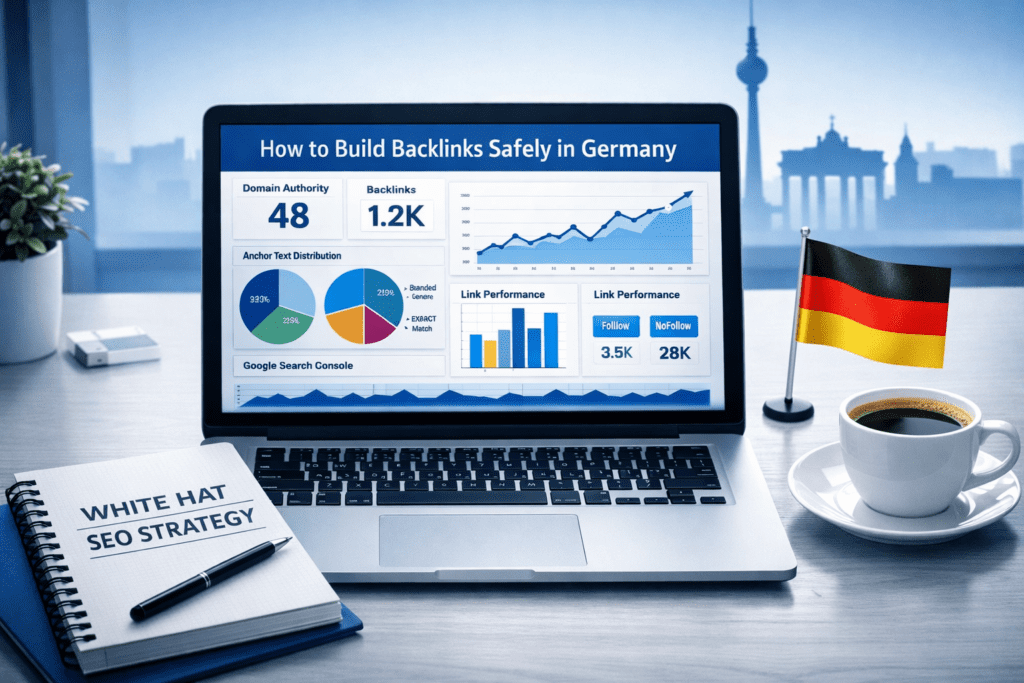
If you want to learn how to build backlinks safely in Germany, focus on relevant websites, useful content, genuine relationships, and transparent outreach. This guide explains practical ways to earn backlinks, evaluate link opportunities, avoid risky tactics, and monitor your backlink profile.
Table of Contents
What Is a Safe Backlink?
A backlink is a link from one website to another. A safe backlink is acquired through a legitimate process that follows search engine spam policies and provides genuine value to users.
For example, a German industry publication might reference your original research because it helps explain a topic to its readers. That editorial link is different from buying hundreds of links from unrelated websites solely to influence rankings.
A backlink should be evaluated by its context, relevance, source, and acquisition method—not simply by a third-party authority score.
Why Backlink Quality Matters
Backlinks can help search engines discover pages and understand relationships between websites. They can also send relevant referral traffic when readers follow them.
However, more backlinks do not automatically mean better SEO performance. A large number of irrelevant or artificially created links may provide little value and can introduce policy risks.
When evaluating a backlink opportunity, consider:
- Relevance: Does the website cover topics related to your business or content?
- Audience: Are its readers likely to find your page useful?
- Editorial quality: Does the website publish meaningful, original content?
- Placement: Would the link make sense in the surrounding text?
- Acquisition method: Is the link earned naturally, or is it part of a ranking manipulation scheme?
A relevant link from a legitimate website can be useful even when the site is not based in Germany.
How to Build Backlinks Safely in Germany
1. Create Content Worth Referencing
Start by creating something that another website would genuinely want to reference.
Useful link-worthy resources include:
- Original research or survey findings
- Practical industry guides
- Detailed tutorials
- Useful templates and checklists
- Expert explanations of a complex topic
- Local resources relevant to German audiences
For example, a company serving German retailers could publish a practical checklist for preparing an online store for a seasonal campaign.
The resource should provide information that readers cannot easily get from a generic article. Do not invent research, statistics, or case studies to make it appear more authoritative.
2. Find Relevant German Websites
Look for websites that publish content related to your industry, audience, or subject.
Potential opportunities include:
- German industry publications
- Relevant professional associations
- Local business organizations
- Industry blogs
- Community websites
- Universities or research organizations, where your content genuinely supports their work
- German-language publications serving your target audience
A website does not become a good backlink opportunity simply because it uses a .de domain or publishes in German.
Review its content, audience, editorial standards, and relevance before contacting the publisher.
3. Use Guest Contributions Carefully
Guest contributions can help you share useful knowledge with an established audience.
Before pitching an article:
- Read the publication’s existing content.
- Identify a topic that fits its audience.
- Prepare an original and useful contribution.
- Follow the publisher’s editorial guidelines.
- Include a link only when it genuinely helps readers.
Do not use guest posting as a way to distribute large numbers of keyword-rich links.
If a contribution is paid or sponsored, the publisher should qualify the link appropriately. A guest article should offer real editorial value rather than exist mainly to pass ranking credit.
4. Earn Links Through Digital PR
Digital PR involves sharing useful information or expertise with journalists, editors, and relevant publications.
A practical process is:
- Identify a topic that is relevant to your industry.
- Prepare useful supporting material.
- Find journalists or publications covering that topic.
- Send a short, personalized pitch.
- Explain why the information may help their audience.
- Respond accurately to follow-up questions.
Possible topics include original research, expert commentary, useful industry resources, or timely explanations of a relevant development.
Do not assume that sending a press release will automatically generate a backlink. Publishers decide whether a story is relevant and whether to link to it.
5. Build Relevant Local Links
If your business serves customers in Germany, look for legitimate organizations and websites connected to your actual business activities.
Possible opportunities include:
- Relevant local business associations
- Industry events
- Community organizations
- Local publications
- Genuine sponsorships
- Business directories that serve a relevant audience
For example, a business participating in a genuine local event may be listed on the event organizer’s website.
Do not join unrelated directories simply to obtain links. Verify that the listing is accurate and useful to people who may visit it.
6. Reclaim Unlinked Brand Mentions
Sometimes a website mentions a company, product, or resource without linking to it.
You can:
- Find the original mention.
- Check whether the page is still available.
- Confirm that the mention refers to your business or content.
- Contact the publisher politely.
- Ask whether adding a link would help readers find the referenced resource.
The publisher is not required to add a link. Keep the request relevant and respectful.
7. Create Useful Partnerships
Working with relevant businesses or organizations can create opportunities for useful content and genuine exposure.
Examples include:
- Co-authoring a useful industry resource
- Participating in a relevant interview
- Contributing expert commentary
- Supporting a legitimate community initiative
Avoid excessive reciprocal linking or agreements that require links solely to manipulate search rankings.
A partnership should provide value beyond the backlink itself.
How to Evaluate a Backlink Opportunity
Before pursuing a link, review the website and the specific page where the link might appear.
Use this checklist:
- Is the website legitimate and relevant?
- Does it publish useful content for real readers?
- Is the proposed link contextually appropriate?
- Is the page accessible and maintained?
- Does the website have a clear editorial purpose?
- Is the link being offered in exchange for payment or another benefit?
- Would the link still make sense if search engines did not exist?
Third-party metrics such as Domain Rating or Domain Authority can help with initial research, but they are not Google ranking scores. Do not use one metric as the sole basis for accepting or rejecting a link opportunity.
Are Paid Backlinks Safe?
Buying or selling links primarily to manipulate search rankings can violate Google’s spam policies.
However, businesses may legitimately pay for advertising, sponsorships, or promotional placements. Links associated with paid arrangements should be appropriately qualified, such as with rel=”sponsored” or rel=”nofollow”, so they do not pass ranking credit inappropriately. Google’s spam policies.
Before paying for a placement, ask:
- What exactly am I paying for?
- Is the placement clearly disclosed?
- Will the link be appropriately qualified?
- Does the publication reach a relevant audience?
- Is the content useful independently of the backlink?
Avoid services promising hundreds of backlinks, guaranteed rankings, or instant authority. Google’s link best practices.
How to Monitor Your Backlinks
Monitoring helps you understand which websites link to your content and identify links that may require attention.
Use Google Search Console
Google Search Console’s Links report can show examples of websites linking to your pages.
You can use it to:
- Review linking websites.
- Identify pages receiving external links.
- Check commonly used linking text.
- Compare link examples over time.
The report is not necessarily a complete list of every backlink on the internet.
Use a Backlink Checker
Third-party backlink checkers can provide additional link discovery and analysis features.
Depending on the tool, you may be able to review:
- Referring domains
- Linking pages
- Anchor text
- New and lost links
- Link attributes
- Estimated authority metrics
Different tools may report different backlinks because they use different crawling systems and databases.
Do Not Disavow Links Automatically
Not every unfamiliar or low-quality backlink requires action.
Google generally recommends using the disavow tool only when there is a considerable number of spammy or artificial links and there is a manual action, or a substantial likelihood of one, related to those links.
If you suspect a problem:
- Review Google Search Console’s Manual Actions report.
- Investigate the links and how they were acquired.
- Attempt removal when appropriate.
- Consider disavowal only when the situation meets Google’s guidance.
Do not disavow links simply because a third-party tool labels them toxic.
Common Link-Building Mistakes
Buying Large Backlink Packages
Bulk packages may include irrelevant, automated, or manipulative links. Evaluate the actual websites and acquisition methods rather than relying on the promised number of links.
Using Automated Backlink Generators
Automated services that create links primarily to manipulate rankings can violate spam policies.
Avoid tools promising instant backlinks without meaningful editorial review.
Repeating Exact-Match Anchor Text
Using the same commercial keyword in many links can create an unnatural pattern, particularly when links are deliberately arranged.
Use natural anchor text that accurately describes the destination.
Publishing Low-Value Guest Posts
Guest articles should offer original information to the publication’s readers. Do not create generic articles solely to place backlinks.
Ignoring Website Relevance
A website does not become a useful backlink source simply because it has a high third-party authority score.
Consider topic relevance, audience, editorial quality, and context.
Disavowing Every Suspicious Link
A backlink audit should investigate the actual circumstances of links. Automatically disavowing every unfamiliar domain is not a sound process.
Frequently Asked Questions
Are paid backlinks against Google’s guidelines?
Buying or selling links primarily to manipulate rankings can violate Google’s spam policies. Paid advertising and sponsorships are different when links are appropriately qualified.
Can I build backlinks without a German website?
Yes. A relevant website does not have to use a German domain to be useful to a business targeting Germany. Consider the website’s audience, topic, and relevance rather than relying only on its domain extension.
What is a backlink checker?
A backlink checker is a tool that identifies and analyzes links pointing to a website. Different tools use different databases, so their reports may not contain exactly the same links.
Should I disavow every low-quality backlink?
No. Google advises using the disavow tool cautiously and only in appropriate situations, such as a substantial pattern of artificial links associated with a manual action or likely manual action.
How long does it take to see results from link building?
There is no fixed timeline. Results depend on many factors, including the website, competition, content, links acquired, and how search engines process changes. No specific ranking or traffic outcome is guaranteed.
Are backlinks important for SEO?
Backlinks can help search engines discover content and understand relationships between pages. Their value depends on context and quality; acquiring more links does not guarantee better rankings.
What is a backlink in SEO?
A backlink is a link from another website to a page on your website. Search engines can use links to discover pages and understand relationships between content.
How can I get backlinks for free?
Create useful resources, contribute genuine expertise, contact relevant publishers, reclaim unlinked brand mentions, and participate in legitimate industry or community activities. These methods require time and effort, and publishers are not obligated to link to your website.
Conclusion: Build Backlinks Through Relevance and Value
Learning how to build backlinks safely in Germany starts with a simple principle: earn links by creating useful content and building genuine relationships.
Focus on relevant websites, meaningful outreach, accurate information, and transparent paid placements. Monitor your backlink profile carefully, but avoid treating every unfamiliar link as a threat.
A sustainable link-building process should support your audience and business goals—not rely on shortcuts designed to manipulate search rankings.
For broader international link-building guidance, explore the related guide to global off-page SEO.