
Last Updated on September 26, 2026
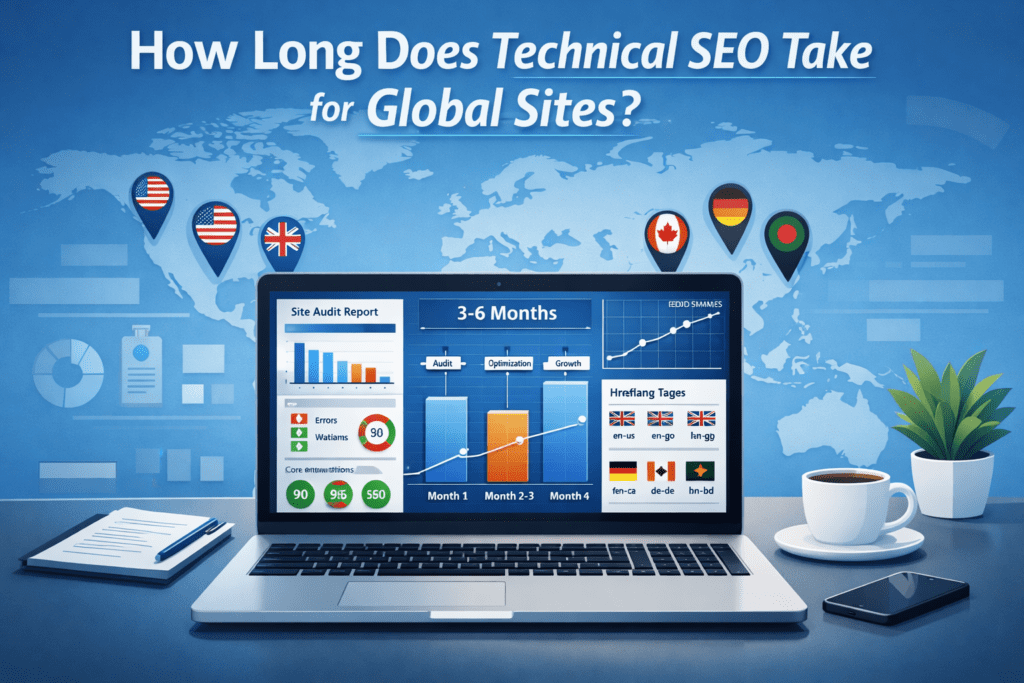
How long does technical SEO take? There is no fixed timeline because every website has a different technical condition, size, architecture, and level of complexity.
For a small website, an initial technical SEO audit and priority fixes may take a few weeks. Larger websites, international sites, and websites with complex crawl, indexing, migration, or hreflang issues can require several months of work, testing, and monitoring. On-Page SEO Services.
The important distinction is between fixing technical issues and seeing the broader impact of SEO changes. A technical issue may be fixed quickly, but Google still needs to recrawl and process the affected URLs, and broader search performance can take longer to change.
Table of Contents
How Long Does Technical SEO Usually Take?
A practical technical SEO timeline can be divided into four stages:
- Audit and diagnosis
- Implementation of priority fixes
- Validation and recrawling
- Ongoing monitoring and refinement
For a relatively simple website, the audit and priority implementation may be completed within weeks. For a large or international website, the process can take several months because there are more URLs, templates, technical dependencies, and regional configurations to review.
There is also no guarantee that completing technical SEO work will produce a specific ranking, traffic, or indexing outcome. Google states that the impact of SEO changes can range from a few days to several months depending on the situation.
What Does the Technical SEO Timeline Include?
Technical SEO Audit
The first stage is understanding what is actually happening on the website.
A technical audit may review:
- Crawlability
- Indexability
- XML sitemaps
- Robots.txt
- Canonical URLs
- Redirects
- Broken links
- Duplicate pages
- Internal linking
- Site architecture
- Mobile usability
- Core Web Vitals
- Structured data
- International SEO configuration
The audit itself can be relatively quick on a small website but may take longer when the site contains thousands of URLs or complicated technical systems.
Fix Implementation
After the audit, issues should be prioritized instead of fixing everything at random.
A useful priority order is:
- Issues preventing important pages from being crawled or indexed
- Major technical errors affecting important templates or sections
- Incorrect canonicalization, redirects, or sitemap configuration
- Important international SEO issues
- Performance and page-experience improvements
- Structural and internal-linking improvements
- Lower-priority technical cleanup
The actual implementation time depends heavily on who controls the website, how complicated the code or CMS is, and whether developer support is available.
Validation and Monitoring
Technical SEO does not end when a developer changes the code.
After implementation, the changes should be tested and monitored.
For example, you may need to check:
- Whether Google can crawl the affected URLs
- Whether important pages remain indexable
- Whether redirects work correctly
- Whether canonical URLs are correct
- Whether XML sitemaps contain the intended URLs
- Whether Core Web Vitals improve
- Whether Search Console shows changes in indexing or crawling
Google recommends using Search Console and URL Inspection to monitor crawling and indexing, and says that crawling can take from a few days to a few weeks in many situations. Requesting indexing does not guarantee inclusion in Google Search.
Technical SEO Timeline by Website Size
There is no official Google timetable that assigns a fixed number of months to different website sizes. The following framework is therefore a practical planning model, not a Google guarantee.
Small Websites
A small website with a relatively simple structure may be able to complete its initial audit and priority fixes within a few weeks.
The process can be faster when:
- The site has few templates
- The CMS is straightforward
- There are no major migration problems
- Developer access is available
- The sitemap and canonical setup are already clean
Medium-Sized Websites
Medium-sized websites usually require more time because there are more URLs, templates, categories, internal links, and technical dependencies.
A project may involve:
- Large-scale crawling
- Template-level fixes
- Redirect cleanup
- Internal-linking improvements
- Sitemap review
- Indexing analysis
- Performance optimization
- Content and technical coordination
Several weeks or months may therefore be more realistic than expecting everything to be completed in a few days.
Large and Enterprise Websites
Large websites can require significantly more technical SEO work.
Common complications include:
- Thousands or millions of URLs
- Multiple website templates
- JavaScript-dependent functionality
- Large faceted navigation systems
- Multiple teams or developers
- International versions
- Complex migrations
- Large numbers of redirects
- Crawl and indexing inefficiencies
For these websites, technical SEO is often an ongoing process rather than a single project with a fixed end date.
What Can Make Technical SEO Take Longer?
Several factors can extend the timeline.
Website Size and Architecture
More URLs generally mean more pages and technical relationships to evaluate.
A simple 20-page website is very different from an international ecommerce website containing thousands of product, category, filter, and regional URLs.
Crawl and Indexing Problems
If important pages cannot be crawled or indexed correctly, resolving those issues becomes a priority.
Problems may involve:
- Accidental noindex directives
- Incorrect canonical tags
- Redirect chains
- Broken internal links
- Poor site architecture
- Sitemap problems
- Blocked resources
- Duplicate URLs
International SEO
Global websites can introduce additional technical requirements.
For example, websites serving different languages or regions may need separate localized URLs and appropriate hreflang annotations.
Google recommends using different URLs for language versions and supports hreflang annotations and sitemaps to help identify language or regional alternatives.
International SEO can therefore require additional testing compared with a single-market website.
Website Migrations
A migration can make technical SEO significantly more complex.
Changing domains, URL structures, platforms, or large sections of a website may require:
- URL mapping
- Redirect implementation
- Canonical review
- Sitemap updates
- Internal-link updates
- Search Console monitoring
- Post-migration crawling
Google notes that significant site changes can take weeks or longer to be processed as Google recrawls and reindexes URLs.
Development Resources
A technical SEO audit may identify issues quickly, but implementation can take much longer if changes require developer work.
For example:
- SEO consultant identifies an issue
- Developer implements the change
- SEO consultant validates the change
- Google recrawls the affected URLs
- Search Console data is monitored
The development workflow can therefore become part of the overall SEO timeline.
What Can You Expect in the First 30, 60, and 90 Days?
These timeframes should be treated as planning stages rather than promises.
First 30 Days: Audit and Priority Fixes
The first stage may focus on:
- Technical SEO audit
- Crawlability review
- Indexing review
- Sitemap and robots.txt checks
- Canonical review
- Redirect problems
- Critical performance issues
- International SEO checks where relevant
The main goal is to identify and address the most important technical barriers.
Around 60 Days: Implementation and Validation
The second stage may include:
- Completing priority fixes
- Improving internal linking
- Resolving technical duplication
- Testing redirects
- Validating sitemap changes
- Reviewing indexing patterns
- Monitoring page experience
- Addressing remaining technical issues
At this stage, the focus should be on whether the implemented changes are working as intended.
Around 90 Days: Monitoring and Refinement
By this stage, a website may have enough data to evaluate broader trends, depending on its size and how frequently Google crawls the affected URLs.
Review:
- Indexed pages
- Crawling patterns
- Search Console performance
- Technical errors
- Important page visibility
- Organic query trends
- Core Web Vitals
- International URL performance where relevant
However, there is no universal 90-day SEO result deadline. Some changes can be processed sooner, while broader improvements can take substantially longer.
How Do You Know Whether Technical SEO Is Working?
Do not evaluate technical SEO only by looking at rankings.
Instead, monitor technical and search signals such as:
- Important URLs becoming crawlable
- Indexing problems being resolved
- Fewer technical errors
- Correct canonical selection
- Better sitemap coverage
- Improved internal linking
- Improved Core Web Vitals where applicable
- More consistent crawling
- Changes in impressions and queries in Search Console
Google recommends Search Console and URL Inspection for monitoring crawling and indexing. Google URL Inspection / recrawl guidance.
A technical SEO project should therefore be measured against the problems identified during the initial audit.
Does Technical SEO Continue After the Initial Fixes?
Yes.
Technical SEO is not necessarily a one-time task because websites continue to change.
New technical issues can appear after:
- Publishing new content
- Installing plugins
- Changing themes
- Updating JavaScript
- Launching new templates
- Changing URL structures
- Migrating platforms
- Adding language or regional versions
Regular monitoring helps identify these problems before they become larger structural issues.
What About Core Web Vitals?
Core Web Vitals measure real-world aspects of user experience, including loading performance, responsiveness, and visual stability.
The current Core Web Vitals metrics include:
- Largest Contentful Paint (LCP)
- Interaction to Next Paint (INP)
- Cumulative Layout Shift (CLS)
Google recommends aiming for good Core Web Vitals as part of providing a strong page experience. However, good Core Web Vitals alone do not guarantee high rankings.
Technical SEO should therefore treat performance as part of the broader website experience rather than as a single ranking shortcut.
Frequently Asked Questions
How long does technical SEO take for a new website?
A new website may need additional time because Google has to discover and process its pages, while the site itself may still be developing its content, structure, and authority. The technical work can begin immediately, but search visibility can develop over a longer period.
Does technical SEO guarantee higher rankings?
No. Technical SEO helps search engines crawl, index, and understand a website, but rankings also depend on factors such as content relevance, search intent, competition, site quality, and other signals.
Does a global website need more technical SEO work?
It can. International websites may have additional requirements involving language and regional versions, localized URLs, hreflang, canonicalization, and international site architecture.
How long does it take Google to recrawl technical SEO changes?
There is no fixed crawl schedule. Google says crawling can take from a few days to a few weeks in many situations, while larger or more complex changes can take longer.
Should I request indexing after updating technical SEO?
For individual important URLs, you can use Google’s URL Inspection tool to request a recrawl. However, requesting indexing does not guarantee that Google will index the URL or that the URL will immediately appear in search results.
Can technical SEO show improvements within 30 days?
Some technical changes can be processed relatively quickly, especially when they resolve a clear crawlability or indexing problem. However, broader SEO changes may take longer, and there is no guaranteed 30-day result.
How long does technical SEO take?
Technical SEO does not have a fixed timeline. A simple website may complete an initial audit and priority fixes within weeks, while larger or international websites may require several months of implementation, validation, and monitoring.
Final Takeaway
So, how long does technical SEO take?
There is no single number that applies to every website.
For a small website, an initial audit and priority fixes may take a few weeks. Medium, large, and international websites can require several months because they involve more URLs, technical dependencies, implementation work, and validation.
The better approach is to think of technical SEO as a process:
Audit → Prioritize → Fix → Validate → Monitor → Refine
If you are working on a global website, start by identifying the technical problems that can prevent search engines from properly crawling, indexing, and understanding important pages. Then measure progress using technical data and Search Console rather than relying on a fixed ranking or traffic deadline.
For businesses that need help identifying and resolving technical SEO problems, you can also review my Professional Technical SEO Services.